

SpaceX is trading below its $155 launch price with no earnings. A Seattle couple has $750K and a $32,000 income cliff coming at 70 that most planners would miss. The IRS is keeping 25% of every missed RMD from people who just hit 73. And a free MAGI calculator just made it embarrassingly easy to see how ACA subsidies, IRMAA, and LTCG can all blow up in the same tax year. The thread running through all of it: the gap between what looks like enough and what actually is.
Editor’s Picks
📉 SpaceX Below $155 Launch Price: Is the AI-Tech Trade Finally Rolling Over?
Source: Early Retirement Forum (Active Investing)
SpaceX is trading below its $155 launch price. No earnings. Years of hype. That is the blunt opener in an Early Retirement Forum thread worth reading slowly. OpenAI and Anthropic are lining up IPOs with no earnings either, running the same late-cycle script as 1999. The profitable software monopolies are floating debt to fund AI capex they cannot yet justify. Corporate users are already trimming token budgets, the first demand-side crack in the unlimited-AI-subscription story. If you have let your tech allocation drift well above market weight, this is the moment to check the math.
Market Implications
SpaceX is trading below its $155 IPO launch price despite years of hype, with no reported earnings to anchor a valuation.
OpenAI and Anthropic are preparing to go public with no earnings, repeating the late-cycle pattern of 1999-2000 dot-com listings.
Warning: The profitable software monopolies are issuing debt to fund AI capital expenditures, meaning earnings dilution is coming even for the names that actually make money.
Corporate users are actively cutting token budgets, the first demand-side signal that unlimited AI subscription models are not sticking.
Key insight: The electricity constraint is real and structural; data center power demand is already outpacing grid build-out in most metro regions.
The forum thread frames this as a question, not a verdict. Nobody called the top in 2000 cleanly either.
🏠 Couple Retiring at 60 with $750,000: A $73K Disability Income Case Study
Source: Early Retirement Forum (FIRE and Money)
$750,000 in Fidelity IRAs. Husband on permanent disability pulling $73,000 a year until 70, then dropping to $41,000 in Social Security. Wife earning $30,000 part-time, eyeing the exit in October. This Seattle couple is sitting in the 12% bracket right now, which is a massive planning gift most people in their position squander. The $32,000 income cliff at age 70 is not the problem. The problem is what they do between now and then with Roth conversions, because that window is closing and they probably do not know it.
Decision Framework
Husband earns $73,000 annually on disability through age 70, then shifts to $41,000 in Social Security, a $32,000/year income drop that must be modeled explicitly.
Wife earns $30,000 part-time and is considering retiring in October 2026 at age 59; losing that income tightens the runway if $750,000 is the only backstop.
Key insight: At the 12% federal bracket, the couple has meaningful room for Roth conversions before the disability income compresses that window at 70.
Pro tip: The years between now and age 70 are the cheapest Roth conversion window this couple will ever see. Fill up the 12% bracket aggressively while $73K is still hitting the account.
Warning: If they hold all $750,000 in traditional IRAs, RMDs starting at 73 will stack on top of Social Security and could push them into the 22% bracket involuntarily.
The thread is a first post from a first-time member. Real-world cases from non-finance people show the planning gaps that polished influencer examples never reveal.
Bonus: ACA subsidy eligibility between October 2026 and Medicare at 65 could easily be worth $15,000 to $20,000 in premium tax credits if MAGI is managed carefully.
⚠️ Miss Your RMD at 73 and the IRS Keeps 25%: White Coat Investor’s Step-by-Step Guide
Source: The White Coat Investor
25% of whatever you should have withdrawn. Gone. That is the RMD penalty if you miss the deadline at 73, and a lot of high earners are hitting that age right now. Dr. Jim Dahle at White Coat Investor walks through exactly how to execute at Vanguard, where December is the cruelest month and a platform processing delay can turn a scheduling mistake into an IRS excise tax. The fix is simple: wait as late as possible in the year to let tax-protected growth run, then get the request in before mid-December.
Withdrawal Framework
RMDs are mandatory starting at age 73 from traditional 401(k)s, IRAs, and 457(b)s; the age rises to 75 beginning in 2033 under current law.
Miss your RMD entirely and the IRS extracts a 25% excise tax on the missed amount. Fix it within two years and that drops to 10%, still a painful and avoidable cost.
Key insight: The White Coat Investor recommends waiting as late as possible in the calendar year to pull the RMD, maximizing tax-deferred compounding without risking a late-December processing error.
Pro tip: First-year RMD takers can delay until April 1 of the year after turning 73, but doing so means two RMDs land in the same tax year and stack income, often pushing into a higher bracket.
Warning: Vanguard and Fidelity both have processing queues that slow in December. Submit your RMD request by mid-December to avoid a year-end backlog that triggers the penalty.
Qualified Charitable Distributions allow up to $105,000 per year to go directly from an IRA to charity, satisfying the RMD obligation without the amount hitting adjusted gross income.
Bonus: If your portfolio is mostly equities and the market is up in December, selling appreciated shares for the RMD is also your rebalancing opportunity. Two birds, one distribution.
🧮 The Cliffedge MAGI Calculator: One Screen for ACA, IRMAA, NIIT, and LTCG Stacking
Source: Early Retirement Forum (FIRE and Money)
Most people track one tax cliff. There are six. ACA subsidy levels. Senior Deduction phaseout. IRMAA Medicare surcharges. Net Investment Income Tax. Taxable Social Security thresholds. LTCG stacking. The Cliffedge MAGI calculator puts all of them on a single page. For anyone in the $80,000 to $200,000 MAGI range, one Roth conversion done without checking all six simultaneously can cost more in lost subsidies and surcharges than the conversion ever saved.
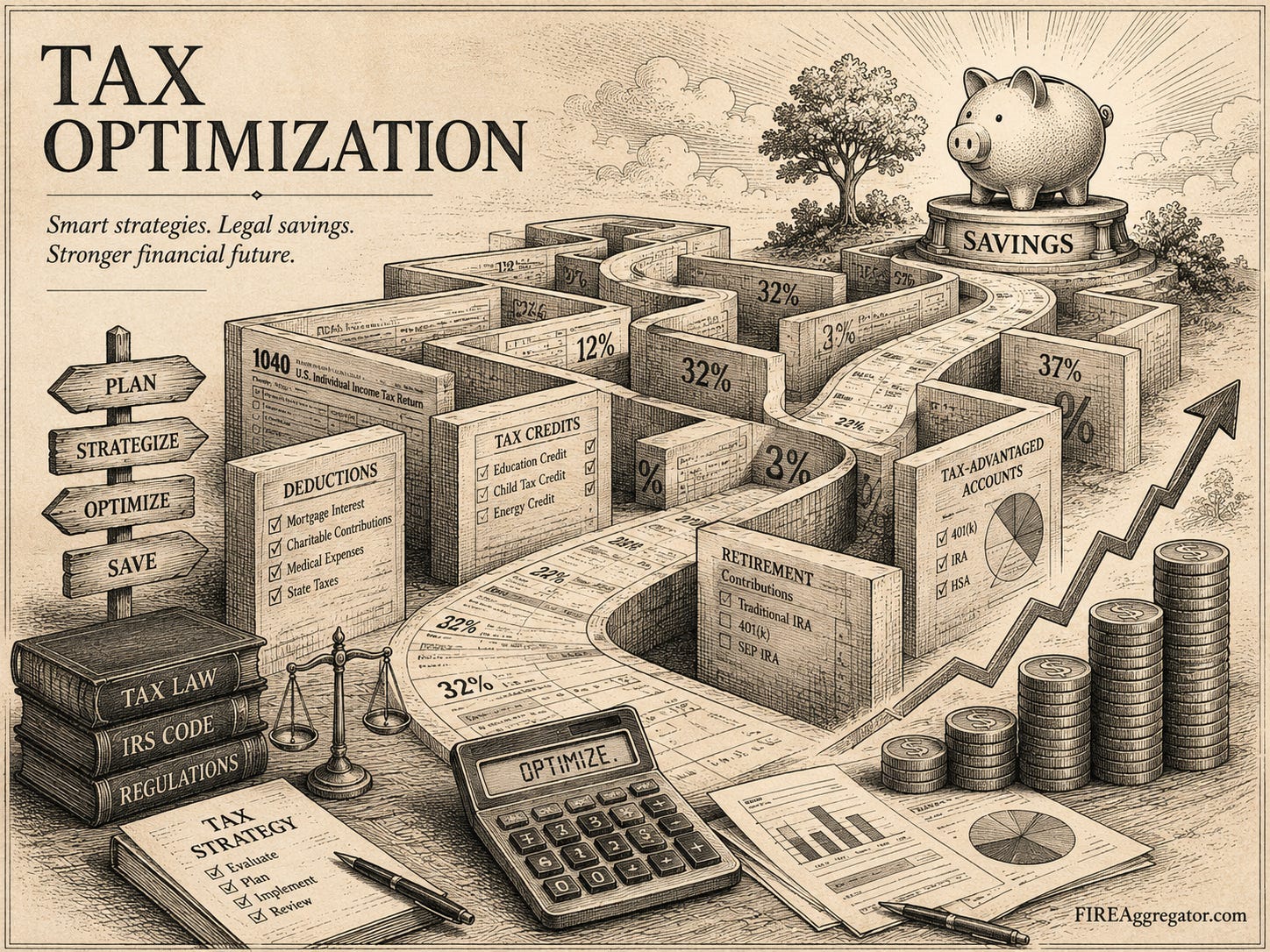
Tax Optimization Plays
The tool maps six simultaneous MAGI cliffs: ACA subsidy levels, Senior Deduction phaseout, IRMAA Medicare surcharges, Net Investment Income Tax, taxable Social Security, and LTCG stacking.
Key insight: IRMAA surcharges are banded; crossing from one bracket to the next can cost $1,000 to $5,000 per year in extra Medicare premiums with a single dollar of excess MAGI.
ACA subsidy cliffs are especially brutal near 400% of the federal poverty level; a $1 overage used to trigger full repayment of premium tax credits before the ARP expansions.
Pro tip: Run Cliffedge before every Roth conversion decision. The interaction between LTCG stacking and ordinary income is the one most DIY investors get wrong.
Warning: Do not use this as a full federal tax estimator; the forum thread is explicit that it is a MAGI-specific instrument, not a replacement for tax software.
NIIT at 3.8% kicks in at $200,000 MAGI for single filers and $250,000 for married filing jointly; some HENRYs hit this on capital gains distributions alone in a strong equity year.
Bonus: For early retirees living off taxable brokerage income before Social Security, this calculator is essentially a free Roth conversion optimizer in disguise.
💵 TIAA-RA Returned 4.74% Over 5 Years While BND Lost 0.26%: The Fixed-Income Case Nobody Talks About
Source: Bogleheads.org
Bond index funds are the default. They are not always the best answer. Over the 5-year window ending June 2026, TIAA-RA compounded at 4.74% while Vanguard’s BND posted negative 0.26%, a gap that compounds painfully at retirement-scale allocations. A Bogleheads thread runs the full comparison: over 4 years, TIAA-RA returned 5.21% against BND’s 4.07%; over 19 years, 4.03% versus 2.91%. The CREF Inflation-Linked Bond fund (QCILIX) adds another layer, averaging 4.57% since 1997 inception at 0.17% expense ratio. If your employer plan includes TIAA and you have been defaulting to bond index funds, this data deserves a hard look.
Investment Insights
Over 5 years (June 2021 to June 2026), TIAA-RA returned +4.74% versus BND at negative 0.26%, a gap of roughly 5 percentage points that compounds painfully in fixed-income allocations.
Over 4 years (June 2022 to June 2026), TIAA-RA returned 5.21% against BND’s 4.07%; over 19 years, the spread is 4.03% vs. 2.91% in TIAA’s favor.
CREF Inflation-Linked Bond (QCILIX) has averaged 4.57% since its 1997 inception at an expense ratio of 0.17%, beating BND over most of the 11 years where ticker data is available.
Key insight: TIAA’s traditional annuity accounts use a smoothed crediting rate, which absorbs volatility in a way bond index funds structurally cannot. That smoothing is not magic; it is a liquidity trade-off.
Warning: TIAA traditional accounts typically come with transfer restrictions and annuitization requirements. The return is real but the liquidity is not equivalent to BND.
Pro tip: If your employer plan includes TIAA-RA or QCILIX and your fixed-income sleeve is currently all BND or AGG, model the switch. The 1.1 percentage point long-run edge is meaningful at $500,000+ allocations.
The Bogleheads thread correctly notes that not all employer plans have access to the CREF Inflation-Linked offering; check your plan documents before assuming it is available.
Quick Hits
Fidelity vs. Vanguard for Cash: Is a 1.25% AUM Fee Worth It?: Rob Berger - Rob Berger tackles five reader questions including whether a 1.25% AUM fee is reasonable (short answer: almost never), which platform wins for cash, and whether handing your finances to an AI is actually safe.
Retail Investors Wanted $70B of SpaceX, Got 30% Allocation vs. the Typical 5-10%: A Wealth of Common Sense - Bloomberg estimates retail demand for the SpaceX IPO hit $70 billion, roughly 30% of the $250 billion total, far above the typical 5-10% retail slice. Ben Carlson argues this retail trading boom is the defining market structural shift of the decade.
Patterns Across Strategies
Fixed income is not monolithic: the TIAA vs. BND gap is a 1.1 percentage point long-run edge that matters at retirement-scale allocations. The MAGI cliff calculator and the RMD penalty piece are two sides of the same problem: most FIRE pursuers optimize accumulation, then sleepwalk into distribution, where six simultaneous tax cliffs can undo years of careful work. The Seattle couple at $750,000 captures the whole tension in one case study: a strong income bridge, a $32,000 cliff at 70, and a Roth conversion window that is open right now and will not be forever. The tech-rollover thread is the uncomfortable backdrop to all of it. Sequence risk is always theoretical until the day it is not.
This post is for informational and entertainment purposes only. It does not constitute financial or tax advice. All data and figures may be subject to error or change. Always consult qualified professionals and do your own research before making financial decisions.